The Important Guide to Recognizing Steel Casting Strategies and Applications
Steel spreading strategies create the foundation of modern-day production. These techniques change molten metal into exact shapes, providing to various sectors. Each method, from sand spreading to financial investment casting, uses unique benefits and applications. Comprehending these methods is necessary for maximizing production processes. As industries evolve, the need for reliable and ingenious casting services grows. What exists ahead for these methods in the face of advancing innovation and changing market requirements?
Overview of Metal Casting Strategies
Metal spreading techniques encompass a selection of techniques utilized to form liquified metal into wanted kinds. These strategies are necessary in different industries, including automobile, aerospace, and art, making it possible for the manufacturing of components with detailed details and complex geometries. The main processes consist of gravity spreading, where metal streams into a mold under its weight, and stress casting, where liquified steel is forced into a mold cavity. Investment spreading, known for its accuracy, uses a wax pattern that is disappeared, developing a highly precise mold and mildew. Pass away casting employs a high-pressure system to create components rapidly, while shed foam spreading combines the performance of foam patterns with accuracy. Each method has its advantages, tailored to particular applications based on variables like material buildings, manufacturing quantity, and desired coating. Understanding these approaches permits manufacturers to choose one of the most appropriate approach for their distinct requirements, enhancing both efficiency and quality in metal production.
Sand Spreading: The The Majority Of Common Technique
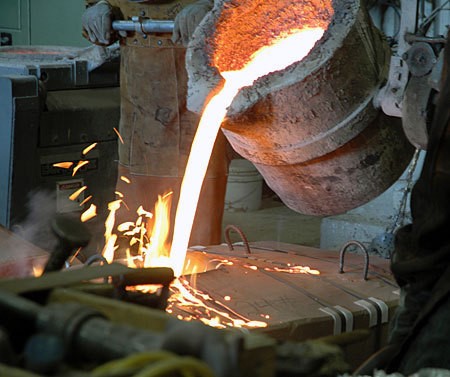
Many casting approaches exist, sand casting remains the most common strategy in the industry due to its convenience and cost-effectiveness. This technique uses sand as a main mold and mildew product, permitting the creation of large elements and intricate shapes. The procedure starts with the development of a mold, typically made from a blend of sand and a binding representative. When the mold and mildew is ready, molten metal is poured into the dental caries, loading every information of the style.
After the steel cools and solidifies, the mold is escaped to reveal the final spreading. Sand casting is particularly preferred for its capacity to fit a broad array of steels, including iron, light weight aluminum, and steel. Furthermore, it appropriates for both small manufacturing and large volumes, making it an excellent choice for sectors such as automobile, aerospace, and construction. Aluminum Foundry. Its simplicity and effectiveness continue to drive its appeal in metalworking
Financial Investment Casting: Precision and Information
Investment spreading is a highly accurate steel casting technique that provides exceptional detail in the end product. This procedure entails developing a wax pattern that is covered with a ceramic product, permitting for detailed styles and smooth surface area coatings. Its advantages consist of the ability to create complicated forms and a vast range of applications throughout various sectors.
Process Review
When precision and intricate detail are extremely important, financial investment casting becomes a preferred method in metalworking. Aluminum Casting. This process starts with producing a wax or polymer pattern, which is after that covered with a ceramic covering. Once the covering hardens, the pattern is thawed out, leaving a mold. Molten metal is poured right into this mold to create the wanted shape. After cooling down, the ceramic shell is eliminated, exposing the actors component. Financial investment spreading permits for tight tolerances and complicated geometries, making it suitable for different materials, including titanium, aluminum, and steel. This method is specifically valued in markets that call for complex designs and premium finishes, making sure that each actors part meets rigid requirements with marginal post-processing
Benefits and Applications
The benefits of financial investment casting expand past its capacity to produce complicated geometries and limited tolerances. This technique allows for the production of comprehensive components with smooth surface area coatings, substantially reducing the requirement for comprehensive machining. Investment spreading is especially useful for making intricate components in fields such as aerospace, vehicle, and medical devices, where precision is essential. Furthermore, it accommodates a large range of materials, consisting of numerous alloys, which can improve efficiency in particular applications. The procedure additionally produces high manufacturing rates, making it financially feasible for both tiny and big sets. Eventually, investment casting stands out for its adaptability, performance, and ability to generate premium parts that fulfill rigid sector criteria.
Die Casting: High-Volume Production
Pass away casting becomes a considerable method for high-volume production, specifically in sectors calling for precision-engineered components. This method entails forcing molten steel under high pressure into a mold and mildew cavity, resulting in parts with exceptional dimensional accuracy and surface area finish. here Normally used with non-ferrous metals such as aluminum, magnesium, and zinc, die casting is preferred for its capacity to produce elaborate forms with minimal machining needs.
The procedure enables rapid production cycles, making it optimal for producing big quantities of parts successfully. Pass away casting is commonly employed in auto, aerospace, and consumer electronics sectors, where reliability and repeatability are crucial. Additionally, innovations in modern technology have caused improved mold layouts and materials, boosting the longevity and life-span of the mold and mildews. In general, pass away casting attracts attention as an essential method for producers intending to meet high manufacturing needs while preserving top quality and cost-effectiveness in their procedures.
Lost Wax Spreading: A Distinct Artistic Technique
Lost wax casting, a method with old origins, has been used for centuries to create intricate metal sculptures. This method entails a number of accurate actions, from crafting a wax version to the final steel pour. Comprehending both its historic significance and the detailed process can illuminate the virtuosity behind this distinct spreading strategy.
History of Lost Wax
Amongst the myriad metal spreading techniques, shed wax casting sticks out for its unique creative expression and abundant historic roots. This approach, thought to go back over 5,000 years, has actually been utilized by various human beings, including the ancient Egyptians, Greeks, and Chinese. Employed for developing detailed fashion jewelry and ritualistic objects, shed wax spreading allowed craftsmens to replicate thorough designs with accuracy. The procedure includes forming a design in wax, which is then encased in a mold and mildew. As soon as heated up, the wax thaws away, leaving a tooth cavity for molten metal. This strategy not just showcases the skill of the artist yet also highlights the social significance of metalwork throughout history, influencing contemporary practices in sculpture and design.
Process Actions Described
The detailed process of lost wax spreading includes numerous thoroughly orchestrated steps that change a wax version right into a spectacular metal artifact. A musician develops a detailed wax design, which serves as the template for the final piece. This version is after that covered with a refractory product to form a mold, adhered to by heating up to allow the wax to melt and recede, leaving a hollow tooth cavity. Next, liquified steel is put right into the mold and mildew, loading the space left by the wax. When the steel strengthens and cools, the mold and mildew is escaped to expose the finished item. Any required finishing touches, such as sprucing up and surface treatment, are used to enhance the item's aesthetic charm and resilience.
Applications of Metal Casting in Various Industries
Steel spreading serves as a fundamental process across numerous markets, offering essential parts for a vast array of applications. In the vehicle industry, it makes it possible for the manufacturing of engine blocks, transmission situations, and different architectural parts, adding to car toughness and performance. The aerospace market makes use of steel spreading for lightweight yet solid parts, such as turbine blades and touchdown equipment, crucial for trip safety.

In building, cast metal elements like fittings and beams improve structural integrity and visual appeal. The energy industry likewise advantages, with cast parts utilized in generators and wind turbines, enhancing performance in power manufacturing. Additionally, the clinical field employs steel spreading to develop precision instruments and implants, highlighting its duty beforehand healthcare modern technology. In general, steel spreading's convenience and performance make it crucial for producing top notch components throughout diverse markets, driving technology and meeting particular functional requirements.
Often Asked Inquiries
What Products Are Frequently Made Use Of for Steel Casting?
Typical products used for metal spreading include aluminum, iron, magnesium, and bronze. These metals are preferred for their desirable buildings, such as melting point, fluidity, and toughness, making them ideal for a selection of applications.
How Does Environmental Impact Vary Between Spreading Approaches?
Ecological influence varies substantially amongst casting techniques. Sand spreading normally has lower discharges contrasted to investment spreading, which uses more energy and creates greater waste. Additionally, methods can influence air and water high quality differently.
What Security Precautions Should Be Taken Throughout Metal Spreading?
During metal spreading, safety and security preventative measures include using safety gear, guaranteeing proper air flow, maintaining equipment, making use of fire-resistant materials, following established protocols, and training workers to manage hazardous products and emergencies properly to decrease risks.
Can Metal Spreading Be Done at Home?
Metal spreading can be done at home, supplied people have the needed tools, products, and safety and security procedures in area. Correct air flow, safety gear, and adherence to guidelines are essential for a risk-free, successful process.
Exactly how Do I Choose the Right Casting Approach for My Task?
Each strategy, from sand casting to investment spreading, uses distinct benefits and applications. The main procedures include gravity casting, where steel streams right into a mold under its weight, and pressure spreading, where liquified steel is forced right into a mold tooth cavity. Many casting methods exist, sand casting continues to be the most common technique in the sector due to its versatility and cost-effectiveness. Investment spreading is an extremely specific steel spreading strategy that uses phenomenal information in the last product. Among the myriad steel casting strategies, lost wax casting stands out for its unique imaginative expression and rich historic origins.